Tuesday, 9 March 2010

Study suggestion #2: Make study notes in lectures

When you think about it, a lot of time is spent during the process of "studying" just rewriting and organising information. Quite often very little revision is going on; you're automatically transcribing from your notes without absorbing anything. For some subjects, multitasking in lectures can save a massive amount of time; however this is only possible in less conceptual subjects. Where the content is easy to understand the first time the professor explains it, it is fairly easy to turn into concise notes as they do so (especially if you have a printout of their powerpoint slides in front of you as well).

In 'information-heavy' subjects, such as physiology, I start making my study notes as soon as I get into the lecture theatre, and even if something complex comes up during the lecture and I get behind, I will already have a head start on the notes. If there's time, I'll go straight to the library and finish them off while the ideas are still fresh in my mind. There's an added bonus: I don't come across a scribbled note a few weeks later which says something like "regulatory activity", which no longer means anything to me. Now my study time is spent actually revising, rather than frantically making notes as it was in first year.

Sunday, 7 March 2010

Study suggestion #1: Find your time

For years I have struggled to work when I'm expected to - i.e. during school hours/after-school homework time, and this has always seemed like the benchmark of how productive I can be. At some point during high school, I started to be allowed to stay up later (that is, after 9pm) working or on the net, rather than going to bed to read. Suddenly I was getting much more done. I'd always just considered myself fast reader, without realising that I was devouring books so fast at night partly because that was when I was most alert.

No matter how hard I try to get assignments done these days in spare time between classes or by getting up early in the morning, I never feel productive. Words come slowly; the process is a painful struggle. I constantly want to go and do something less cerebral - make dinner, water my plants, go running. I eventually chain myself to my chair the night before the assignment is due, and try to force myself to work by refusing to even leave the computer. The struggle continues (and when I say "struggle", I mean "minesweeper"), until about 10pm. Suddenly I find myself working ten times faster than I have been all day.

Of course, I know that my optimal working time is late in the evening, but for some reason I seem to forget this during the day. In the end I just give up in frustration. When I do realise why I've been so unproductive, the stress all melts away.

In short, an important part of time management is recognising when you're most productive, and scheduling everything else around it so the most important tasks fall in that time. For example, one should not write blog posts in "productive time" when there is an essay to be worked on. Oops.

Thursday, 25 February 2010

Hurrah, hurrah...

...another year begins. So much for posting all about my CSIRO job! My research turned out to be a little disappointing - not the project itself but my mediocre results. Nonetheless, I learned more than I ever wanted to know about wheat growth, got to mess around with chemicals, and go to Canberra and hear about lots of other interesting projects, so not to worry. Also I did a little bit of stats work in R, which I've never used before, so that was educational (if a bit painful).

In non-science news, moving house is finally sort-of complete. The new place is much bigger & we now have a dedicated office/study room, so hopefully that yields some more productive studying (hah). Also, I've got lots of balcony space for plants, so I can continue my experiments on the topic: Do my plants die because I neglect them, or is Brisbane weather just too ridiculous for gardening?

New units for 2010/1:
  • Functional Biochemistry - need to brush up on some organic chem, unfortunately :(
  • Biomedical Research Technologies - includes a welcome stats refresher
  • Genetic Research Technologies - arghh, problem-solving workshops again
  • Plant Genetic Manipulation - apparently we get to make some transgenic tobacco?

Friday, 2 October 2009

Good News, Everyone!

I'm not going to whinge about how bad I am at posting... promise! Just wanted to share how excited I am - I've been accepted into a summer studentiship with CSIRO!! It's in the area of plant biotechnology but I don't yet know which project I'll be working on. Scary part - at the end we all get flown to Canberra to give a talk on our findings. It'll be great to hear what all the other students worked on, but I haven't done public speaking since high school... I'm already getting stage fright :( Hopefully there's not too many people! Should be lots to blog about over the summer, then. I've also booked our post-exams holiday to Tasmania, I kind of wish I was there already. That's all for now, I need to get back to the genetics assignment I've been avoiding all week. (The only positive outcome of this is that my house is now really clean, all my clothes are washed and the fridge is full of food. Maybe I should avoid things more often, it makes chores really attractive.)

Ooh, last minute - I've booked to go to a talk by Richard Dawkins - yes it's not until 2010, but there's only one night so I figured I'd get in early. Preaching to the converted, I know, but it's pretty cheap and I expect he'll talk about his new book which I've been reading (which is great, btw).

Tuesday, 7 April 2009

Rain, exams and the case for chemistry in the kitchen

Ugh, exams... exams and rain. Actually, I don't mind the rain in the slightest - the cool change is lovely, and water on the road tends to muffle the traffic roar to which I've become accustomed. Physiology and Micro midterms done (and they weren't so bad, either); Bichem's on Thursday and Molcular Bio isn't for two weeks, so I'm not too worried.

Worse is my book pile - it teeters at my bedside, threatening to crush me in my sleep. I've not read any more Dawkins, and that's on top of about five half-done novels, two new ones I impulse-bought today (Nick Hornby and Johnathan Safran Foer) and recursively, a book about reading (the auther is just as negligent as me, I'm afraid, so it's not helping in the least). Not to mention the inch of science magazines. Bring on Easter break!

Speaking of Easter, this is me reminding myself: post the awesome recipe for lemon tarts. Hey, it's sort of scientific, cooking is half chemistry, half physics after all. Citric acid and sucrose do nice things to the tongue! And then there's eggs denaturing in the oven... maybe I should turn this into a blog for kitchen chemists.

Thursday, 26 March 2009

Cumulative Selection

I'm sick of studying but I haven't much to blog about. Solution? Quote Dr. Dawkins!

"It is amazing that you can still read calculations like my haemoglobin calculation, used as though they constituted arguments against Darwin's theory. The people who do this, often expert in the their own field ... seem sincerely to believe that Darwinism explains living organisation in terms of chance - 'single-step selection' - alone. This belief, that Darwinian evolution is 'random', is not merely false. It is the exact opposite of the truth. Chance is a minor ingredient in the Darwinian recipe, but the most important ingredient is cumulative selection which is quintessentially nonrandom."
~ The Blind Watchmaker, Chapter 3, 1986


As I read this book I keep getting the uncanny feeling Dawkins is reading my thoughts. Early on, he mentions that natural selection is not purposeful, just an inevitable occurrence when you have variation within a population that reproduces and passes on its characteristics. I thought to myself that thinking this is in some way directed is like thinking that a sieve in a river catching large but not small objects is doing it for a purpose. This organisation out of chaos is not for anything, it's just a consequence of how sieves work. Two pages later and he's talking about sieves. I guess it's just a common example.

Wednesday, 18 March 2009

DNA Extractions

As I've mentioned before, there are certain moments in the string of routines, adjustments, retries and self-corrections that makes up an experiment which are particularly beautiful or elegant. It's generally the moment when it all makes sense, when you end up with a number which proves that the past three hours of pedantic measuring was not in vain.

In our extraction of DNA (from chicken liver in Molecular & Cellular Regulation), that moment didn't come at the end at all. Yes, we've since got those all important numbers from spectrophotometry and electrophoresis, but the awesome part is the fiddliest. The DNA and a bit of other sludge (proteins etc) are in the bottom of the tube, topped with a layer of ethanol (pipetted ever so carefully down the side of the glass so they don't mix). In goes your glass rod, and ever so delicately you dip it past the interface and swirl it around in the DNA to wind a few strands onto the rod. It's like making the world's tiniest stick of fairy-floss. The strands precipitate out when they reach the ethanol, and hang there, translucent, the stuff we're made of.

I don't believe humans have a 'soul', or anything more than the sum of our parts, than the complexities of the brain. I find it hugely more impressive, more inspiring and wonderful to think of the intricacies of how we work, come about over millions of years by a process born out of randomness and determined by the ability to survive, than to propose that we are something more mysterious.

Year #2

With second year comes... more failed resolutions to post often, it seems. I will endeavour.

Meanwhile, my classes all feel a lot more focused. Currently my minor ("co-major") is Life Science Technologies, which translates to 'pick some stuff you're interested in from the life sciences'. However I'm considering changing it to biomolecular science, or even making biochem my minor and changing major to biomolecular. Anyway, I have plenty of time to decide because they have so many units in common. This semester, it's Microbiology, Molecular and Cellular Regulation, Biochemistry and Medical Physiology. As usual I'm not a huge fan of microbiology, but I'm enjoying the others, even (gasp) physiology.

Med Phys is interesting in that we don't have lectures; the material is all online and backed up in the tutes and pracs. I'm quite enjoying this (more time sleeping in the morning!) but I think other subjects wouldn't be so suited to it. We've also got the benefit of a really well-made website, which is vastly better than my experiences with textbook-linked websites made by book publishers. Thankfully none of those are compulsory this time around.

Monday, 1 December 2008

Exam season comes to an end

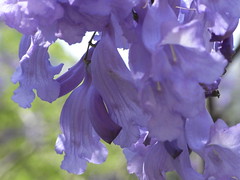
Well, I certainly haven't posted in long enough, but I'll stick to exams as my excuse. As the jacrandas start flowering in spring, students on the east coast of Australia develop permanent nervous expressions. I didn't do as well in Organic Chemistry as I'd hoped, but that should be ok as I don't have any more pure chemistry units from now on. Physics and Physiology were both HD's! I was surprised Physiology was my highest result, but then I thought the final exam was perfectly pitched.

And now, holidays! I'm hoping to get a lot done, but I'm sure I'll end up spending many an hour lying around with a book instead, which is fine. Plans include a little photography, a little drawing, a new PC and maybe even a little blogging (gasp!).

Monday, 19 May 2008

15 Biotech Breakthroughs Which Will Affect You

I know, I know, enough with the linking to lists of links, but this was an interesting one. Here's a list compiled by TechnutNews which includes recent breakthroughs and cutting-edge research, from affordable gene sequencing to curing major diseases. I, of course, am fascinated by Scientific American's article about open source principles being applied to science. Enjoy!

Learn Stuff For Free: IT Edition

Here is a great list of free resources for learning about computer technology online - not really relevant to this blog, but I thought it was useful enough to mention. The web is naturally brimming with technology-related guides, FAQs and HOWTOs, but if you'd like something a little more structured, this list includes full courses including those from open university projects like MIT's OpenCourseWare.

Sam Harris on Stem Cell Research and Morality

I think Sam Harris here does a very good job of presenting a logical, reasonable treatment of the confusion inherent in the argument that to use an embryo for stem cell research is to destroy a human soul. His examination of the problems with this argument remain viable even if you are a religious person; that is, he goes further than just discounting the argument by rejecting belief in human souls altogether.


Tuesday, 8 April 2008

Titrations!

...seem to be all we are doing in Chemistry at the moment, but I'm actually ok with it. I love the magical moment when you add one more drop of acid and suddenly your solution reaches a tipping point, changes colour, and you know its concentration. I'm not too keen on associating "magical moments" with chemistry, but it seems the only way to describe it; it's fascinating how we measure chemicals into our glassware, somewhat messily, trying to achieve the equivalent of the pure logic of the equations in our textbooks - and most of the time to our astonishment it works.

It's also nice working in the lab on the top floor; the class starts at 9am and though the sun hasn't yet reached between the other buildings it reaches us up there; by chance you can look out a window and catch a glimpse of the river and a ferry going by.

Now I think of it though, all this general appreciation of our Chem pracs is probably something to do with my doing three titrations in a row which agreed to near-perfection - precisely, 19.8, 19.7 and 19.7 mL. I never expect the numbers to come out quite right in experiments, but it's infinitely satisfying when they do.

Friday, 2 November 2007

Learn Stuff For Free

Here's a pretty comprehensive list of colleges and universities (mostly in the US) which offer course content for free online, such as videos or podcasts of lectures, course notes, exercises, and sample exams. I've never done a full course this way but I've looked at a fair bit of MIT's Biology content out of interest and it was pretty good, both in content quality and production quality. More here than you could ever hope to learn, but it's all for the great price of nine ninety-free, so there's nothing to lose! (Hint hint: uni I am going to be in debt to: you'd better be awesome!)

11 fantastic images of planet earth

These photos are all taken from space and show some phenomena from a point of view we don't usually see - such as my favourite, a total solar eclipse from above. Not a very 'hard science' first post, but hey, it's Friday.

It's also November 2nd, and I'm doing NaNoWriMo this year, so I'm busy pounding the keyboard for purposes other than blogging. This is my 4th year at it, and I'm determined to (finally) write a 50,000 word novel in 30 days. No exams to interfere, and no homework I should be doing - it's going well. 2500 words or so, if you're interested ;-)

Thursday, 1 November 2007

10 PRINT "HELLO WORLD"

This is a blog for my ramblings about biochemistry. I have finally enrolled in Applied Science at QUT, Brisbane, something which for a while I doubted would ever happen. But amazingly, I chose my first-year units last night (I'm majoring, obviously, in biochem), so it looks like it might be imminent after all. Hurrah! I am terribly excited. I've had a year "off" since school, not something I wanted to do, but I needed to work. The waiting made me both more nervous and more eager to get out of here and start studying. Yes, I like study. Don't tell me I have no life - it says "Geek" right there in the title, doesn't it? Exactly. So if you like biology, biochemistry, and off-topic discussions of scientific method, climate change, evolutionary theory, bunnies, and why ramen is the ultimate food: welcome. It will be fun!